Agenda NatiDems Meeting
August 12, 2026
Meeting agenda will be announced soon.
June 10, 2026
6:30 PM Greater New Light Church
710 N. Shuttlesworth Rd
Cincinnati, Ohio
Agenda
Upcoming CDC Elections
Black Caucus
By-laws including membership
To Do List: need workers
April 2, 2026
| NatiDems.orgNative Democrats — Building Democratic Power |
| MEETING AGENDA WITH SPEAKER’S REMARKS | Thursday, April 2, 2026 |
| DateThursday, April 2, 2026 | SpeakerDonald Washington, Coordinator | Hosted byNatiDems.org | Hamilton County |
| AGENDA ITEM 1 OF 6 |
| 1 | Opening Statement: What is NatiDems.org? | ~5 min |
• Welcome and introductions
• Mission, vision, and purpose of NatiDems.org
• Overview of today’s agenda
SPEAKER’S REMARKS— Donald Washington, Coordinator |
| AGENDA ITEM 2 OF 6 |
| 2 | The Future of Democratic Leadership: Making It Responsive to the Black Community | ~20 min |
• Current state of Democratic Party engagement with Black voters
• Strategies for inclusive leadership and representation
• Community priorities and policy alignment
• Open discussion
SPEAKER’S REMARKS— Donald Washington, Coordinator |
| AGENDA ITEM 3 OF 6 |
| 3 | What Cincinnati Precinct Plan Is Doing | ~15 min |
• Quick overview of the CPP
SPEAKER’S REMARKS— Donald Washington, Nijita or Raffel |
| AGENDA ITEM 4 OF 6 |
| 4 | Developing a Black Caucus for the Hamilton County Democratic Party | ~20 min |
• Rationale and goals for establishing a Black Caucus
• Structure, membership, and governance framework
• Relationship to the broader Hamilton County Democratic Party
• Next steps and call to action
SPEAKER’S REMARKS— Raffel Prophett, |
| AGENDA ITEM 5 OF 6 |
| 5 | Campaign Guide for Precinct Executives: Methods and Methodology | ~8 min |
-Finding Voter data and how to use it
SPEAKER’S REMARKS— Charles Thompson |
| AGENDA ITEM 6 OF 6 |
| 6 | Closing Remarks |
• Comments from Past and Present PEs
Summary of action items and next steps
• Upcoming events and announcements
• Adjournment
SPEAKER’S REMARKS— Donald Washington, Coordinator |
| NatiDems.org | Hamilton County Democratic Party | Cincinnati, OhioStrong 4 Change |
March 5, 2026
Opening Remarks-Introductions
Introductions:
-Donald Washington
Thanks, participants, for being here, thanks, Greater New Light Church, for the use of their facilities, thanks to the people who put this meeting together, and provided logistical support. To create more time for discussion, we will go off script a little, but we encourage you to read the entire meeting agenda at some point.
Why are we gathered here? Over the past 25 years, we have successfully elected more Black officials. What has been missing is the same level of success in the grassroots of the Party, particularly Black PEs. Before this effort, initiated by CPP, to increase the number of PEs, 81 of 190 precincts in the City were vacant, the majority in Black or other underserved communities, and county-wide, 283 out of 562 PE slots were vacant. Here is the good news: Depending on the number of write-ins, fewer than 20 PE spots in the City will be vacant after the primary (appointable), and the number of vacant PE slots in the county, outside of Cincinnati, will be less than 50. 500 people are running to be PEs, an unprecedented number!
We believe this lack of grassroots involvement is part of the problem when attempting to get the City and County to address the problems of Black people in deep structural ways. Another factor is the kinds of PEs. We need PEs, especially in the Black community, to be activist PEs, engaging their precinct citizens and pushing for policy changes that will improve the conditions of Black Hamilton County residents.
Even with the decades of Democratic rule in the City and monopoly on County leadership, the Black community is no closer to parity, too many are “stuck in place.”..
Before the upcoming primary, there were PE vacancies in xx the precincts. Many people had no idea what a PE is or does.
What is NatiDems- Why we wish to transform the HCDP and move our community to parity.
Cincinnati Black Democrats exists to amplify Black voices within the Democratic Party, transform our community through political empowerment, and advance an agenda that delivers tangible results for all Cincinnatians.
We are committed to building a more representative party leadership by recruiting, training, and supporting Black Precinct Executives (PE) who will drive meaningful change from the ground up.
The Imperative for Change
Black Cincinnatians deserve representation that reflects our community’s diversity, understands our lived experiences, and fights relentlessly for our interests. For too long, decisions affecting Black neighborhoods have been made without community-responsive Black leadership at the table. Precinct Executives are the foundation of party power—they elect party leadership, influence endorsements, and mobilize voters. When Black Democrats hold these positions in proportion to our community’s presence, we shift the entire political landscape toward justice and equity. We pursue this mission because incremental change is no longer sufficient. Our children deserve excellent schools now. Our families deserve safe, affordable housing now. Our communities deserve economic investment now. By organizing Black Democrats into positions of power and pushing the party toward bold, progressive solutions, Cincinnati Black Democrats transforms political engagement into political power, and political power into the real, lasting change our city needs.
Background: African Americans are underrepresented as PEs
Currently, there are scores of PEs vacancies throughout the county, especially in the City of Cincinnati. Many vacancies are located in Black and underserved communities. Vacant Precinct Executive (PE) seats in Black neighborhoods have significant, concrete implications for political power, resource allocation, representation, and the effectiveness of those communities in influencing the Hamilton County Democratic Party (HCDP). When Black neighborhoods lack PEs, those neighborhoods lose voting power inside the party. Decisions about candidate endorsements, party rules, leadership choices, and strategic priorities are made without proportional representation from those communities. It effectively dilutes Black political influence at the most fundamental level of party structure. Essentially: No PE = no vote = no voice.
Engagement: Engaging Black Democrats in Civic Life and Party Politics
Engagement begins with relevance. We host regular community forums that address the issues that matter most to Black Cincinnatians—economic opportunity, educational equity, criminal justice reform, affordable housing, and healthcare access. These forums serve as entry points for Democrats who may feel disconnected from traditional party structures. We organize voter registration drives, candidate meet-and-greets, and issue-based campaigns that allow Black Democrats to see their direct impact on political outcomes. Through social media, newsletters, and partnerships with local Black-led organizations, we maintain consistent communication that keeps our community informed and mobilized. We also create pathways for political education, offering workshops on everything from understanding local government to effective advocacy techniques. By celebrating our wins, acknowledging our setbacks, and always maintaining transparency about our work, we build trust and sustained participation.
Goals: Building Black Leadership in Every Precinct
Our primary goal is to dramatically increase the number of Black Precinct Executives in the HCDP. We are organizing an effort to create a Hamilton County Democratic Party Black Caucus. We achieve this by identifying passionate community members in neighborhoods throughout Hamilton County, providing comprehensive training on the responsibilities and powers of Precinct Executives, and creating a supportive network that sustains new leaders through their first terms and beyond. We actively recruit from civic organizations, churches, neighborhood councils, and grassroots movements, seeking individuals who are already invested in their communities and ready to formalize that commitment through party leadership. By demystifying the process of becoming a Precinct Executive and offering mentorship from experienced leaders, we remove barriers to entry and ensure that Black Democrats have both the knowledge and confidence to step into these critical positions.
Why PEs are Important
Here is a quote from David Pepper, former Chair Ohio Democratic Party
….Now, amid all text banks and digital messages and fancy TV ads aimed at voters, do you know what single change would forever lift turnout and alter outcomes in American elections more than any other? Everywhere?
Simple: if every Democratic precinct executive or committeeman, or committeewoman in this country took ownership of the precinct she or he is elected to represent. If they all made the simple decision to engage (permanently) and organize the manageable number of residents living in those small geographic regions.
It’s that straightforward.
—-
Precinct Executives are really the backbone of the party’s political operation, and their importance flows from both their formal powers and their grassroots role.
On the formal side, Precinct Executives make up the Central Committee, which means they collectively elect the party’s leadership and can fill vacancies in Democratic county-level elected offices. This is significant — if a Democratic county commissioner, judge, or other officeholder steps down or dies in office, it’s the Central Committee (i.e., the Precinct Executives) who appoint the replacement, not the voters. That’s a real and direct form of political power.
On the grassroots side, Precinct Executives are the party’s eyes and ears in every neighborhood. A precinct is a small geographic unit — often just a few hundred households — and the Precinct Executive is supposed to personally know the Democratic voters in that area. They knock doors, make phone calls, distribute slate cards on Election Day, and help register new voters. This kind of hyper-local contact is something no amount of television advertising or mass mailers can fully replicate. Research consistently shows that personal contact from a neighbor or a familiar face is one of the most effective ways to turn out voters.
There’s also a structural urgency to filling these roles. Hamilton County has hundreds of precincts, and many Precinct Executive slots go unfilled or are held by people who are not very active. When a precinct has no active Executive, the party essentially has no organized presence there — no one knocking doors, no one distributing literature, no one tracking who has and hasn’t voted. In a county like Hamilton, which includes Cincinnati and has been increasingly competitive, those gaps can make a real difference in close elections.
In short, Precinct Executives matter because they connect the party’s institutional power to real voters on the ground, and because their collective vote shapes who leads the party and who fills its offices.
Structure of the HCDPand the role PEs play
-Raffel Prophett
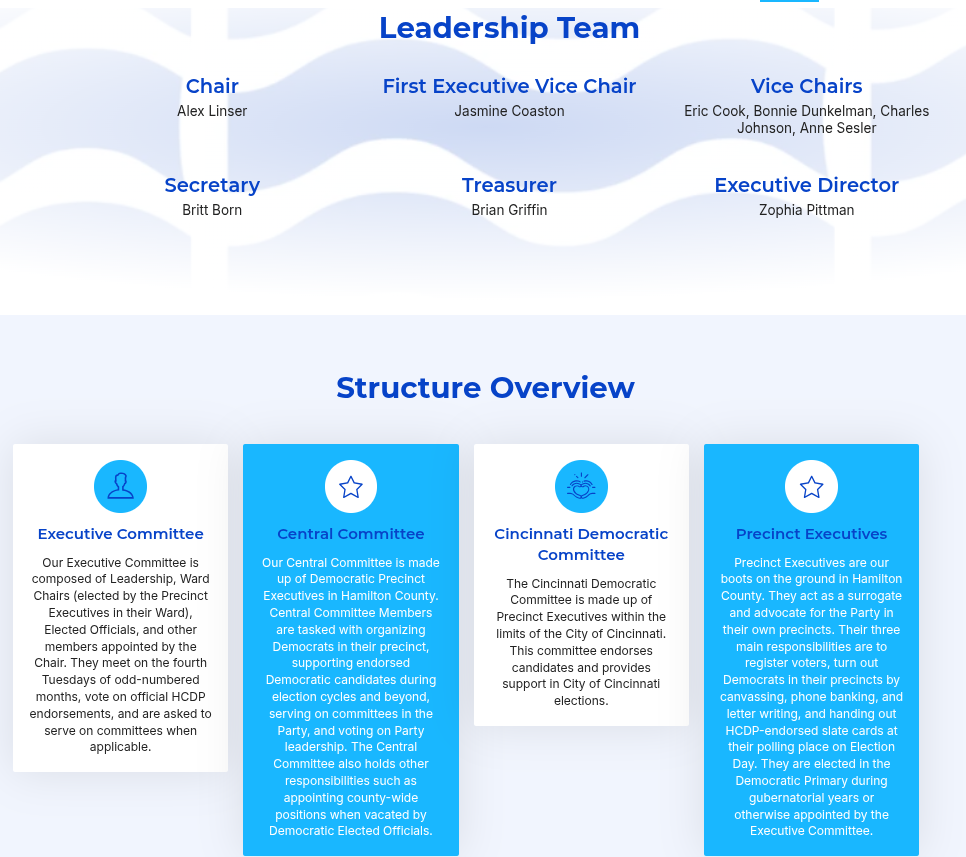
The Hamilton County Democratic Party (HCDP) is organized around four interconnected levels, moving from executive leadership down to neighborhood-level organizing. At the top sits the Executive Committee, which is composed of party leaders, elected Democratic officials, and appointees. This committee handles broader party decisions, including candidate endorsements — which follow a screening process where a Nominating Committee presents recommendations — and meets on the fourth Tuesday of every odd-numbered month.
The controlling body of the party is the Central Committee, which is composed of Democratic Precinct Executives elected during the primary election every four years from each precinct in Hamilton County, in accordance with the Ohio Revised Code. The Central Committee elects the Executive Committee and holds significant authority over party governance. Central Committee members are tasked with organizing Democrats in their precincts, supporting endorsed candidates, serving on party committees, and voting on party leadership. The Central Committee also holds the important power of appointing individuals to fill county-wide positions vacated by Democratic elected officials.
A notable sub-body is the Cincinnati Democratic Committee, which is made up of Precinct Executives within the city limits of Cincinnati specifically. This committee focuses on endorsing candidates and providing support in city elections, giving Cincinnati’s urban core a distinct organizing voice within the broader county structure.
At the most local level are the Precinct Executives themselves — the grassroots foundation of the whole organization. Their three main responsibilities are registering voters, turning out Democrats in their precincts through canvassing, phone banking, and letter writing, and distributing HCDP-endorsed slate cards. Precinct Executives are elected during gubernatorial-year Democratic primaries, and vacancies can be filled by appointment from the Executive Committee.
The whole structure is governed by a formal Constitution and Bylaws, which must align with both the Ohio Democratic Party’s and the national Democratic Party’s governing documents. The party also holds a biennial strategy summit and maintains several standing committees focused on areas like fundraising, communications, and candidate development.
What is the CPP?
-Nikita Anderson
The Cincy Precinct Project is a grassroots political organizing effort in Cincinnati aimed at transforming the Hamilton County Democratic Party from within. Here’s the gist:
The Problem They’re Addressing: They believe the Hamilton County Democratic Party is currently unresponsive to the needs of Cincinnati’s working class.
Their Strategy: The Hamilton County Democratic Party’s voting body is made up of neighborhood representatives called precinct executives — there are more than 500 of them across the county. The Cincy Precinct Project plans to run candidates to replace as many of these precinct executives as possible in the May 2026 elections, to fundamentally change the party’s membership, leadership, candidate recruitment, and priorities.
Their Vision: They want Cincinnati to become a city with robust public transportation, accessible neighborhood grocers, world-class public education, and strong social services for residents at every stage of life — essentially a more progressive, working-class-focused local government.
In short, it’s a bottom-up effort to take over the local Democratic Party structure by winning internal party elections — a strategy sometimes called a “precinct strategy” that has been used by various political movements across the country.
Why NatiDems is collaborating with CPP
We share a clear common mission and strategy, and there’s a strong case for collaboration.
Both groups are focused on the same mechanism of change: electing Precinct Executives (PEs) within the Hamilton County Democratic Party ahead of the May 2026 elections. Both believe the current HCDP fails to serve Cincinnati’s working people and that the path to fixing it runs through filling and flipping PE seats — the foundational layer of party power that controls leadership elections, candidate endorsements, and party priorities. Neither group is trying to start a third party or run independent campaigns; both are working inside the Democratic Party structure to transform it from the ground up.
Why Collaboration Makes Strategic Sense
Their work is naturally complementary rather than competitive. NatiDems (Cincinnati Black Democrats) is specifically focused on recruiting, training, and supporting Black Precinct Executives, particularly in Black and underserved neighborhoods where PE seats are disproportionately vacant. The Cincy Precinct Project has a broader working-class-focused agenda across Hamilton County generally.
Together, they address a gap that neither could fill alone. NatiDems brings deep community trust, targeted outreach through Black churches, civic organizations, and neighborhood networks, and a focused mission of racial representation. The Cincy Precinct Project brings a countywide organizing framework and a broader coalition. If NatiDems fills vacant PE seats in Black neighborhoods and the Cincy Precinct Project fills seats across the rest of the county, they could collectively hit the critical mass needed to actually take majority control of the HCDP’s voting body.
Put simply: they’re playing on the same field, running the same play, and their target constituencies overlap just enough to be mutually reinforcing without being redundant. A coalition between them would be more powerful than either acting alone.
How to effectively campaign and canvas your precinct(Nikita)
THE 5 STRATEGIES
🚪 Door-to-Door Canvassing Recruit & train volunteers · Use VAN walk lists · Canvass weekends 10AM–6PM · Script: introduce candidate, ID support, leave lit
📞 Phone Calls Set up virtual phone banks · Target sporadic Dem voters · Call Tue–Thu evenings · Track support / undecided / oppose
📧 Email to Democratic Voters Build list from voter file · Send bi-weekly newsletters · Segment by turnout propensity · GOTV blast 3 days before election
🏛️ Attend Local Meetings City council & school board meetings · Host town halls by neighborhood · Table at Dem Party events · Collect contacts everywhere
🪧 Signs Order yard signs & banners by Month 1 · Place in high-traffic corridors · Offer to strong supporters at the door · Banners near polling sites
What tools and support are available to you as a new or prospective PEs
Canvassing material
Website and social media
Design support
Data/Tech support
Funding?
Voters List- Board of Elections, Democratic Party?
How can we support one another to maximize the number of elected Black PEs?(Raffel)
Before the May 2026 Election: Winning the PE Seats
The PE election happens during the Democratic Primary in May 2026. Each precinct elects its own PE, so these are small, hyperlocal races. Black precincts can help each other win in several concrete ways:
Candidate Recruitment Across Precincts. The biggest problem NatiDems identifies is that many PE seats in Black neighborhoods are simply vacant — nobody is running. Neighbors who already know the community can fan out and recruit candidates precinct by precinct. A trusted face from one block asking a neighbor on the next block to run is far more effective than a cold call from a party official.
Shared Canvassing and Voter Turnout. PE elections are won by tiny numbers of votes — sometimes just a handful of Democratic primary voters in a precinct need to show up and vote for the right person. Volunteers from adjacent precincts can cross into neighboring precincts to knock doors, make phone calls, and drive turnout for the PE candidate. Because the primary electorate is small, even a few dozen activated voters can flip a race.
Pooling Resources. Individually, a single precinct-level candidate has almost no budget or staff. But if 20 or 30 Black precinct candidates coordinate, they can share flyers, split printing costs, do joint literature drops, and share a common slate card — making each campaign far more viable. A collective “vote for all of us” message is also more memorable than 30 separate messages.
Training Together. New candidates who have never run for anything can be intimidated by the filing process, ballot requirements, and campaign basics. Experienced community members who have run before, or who are further along in preparation, can host joint training sessions so nobody has to figure it out alone. NatiDems is already building this infrastructure.
Summary: Wielding Power Inside the HCDP
Winning the seat is only the beginning. Once elected, PEs vote collectively on party leadership, endorsements, and rules. This is where cross-precinct coordination becomes even more powerful.
Bloc Voting on Leadership. Within 15 days of the primary results being certified, all elected PEs meet to elect the officers of the Hamilton County Democratic Party. If Black PEs from across the county have agreed in advance on a slate of candidates for party leadership, they can vote as a unified bloc. A coordinated bloc of 50–100 PEs is enormously influential, potentially decisive, in those leadership elections.
The Cincinnati Democratic Committee (CDC). PEs within the City of Cincinnati are also automatically members of the CDC, which makes endorsements for Cincinnati City Council, Cincinnati School Board, and city ballot issues. This is hugely consequential for Black neighborhoods. A coordinated caucus of Black PEs on the CDC could shift which council candidates get the party’s endorsement — and the resources and credibility that come with it.
Ward-Level Coordination. PEs within each Cincinnati ward elect their Ward Chair. If Black PEs hold enough seats within a given ward, they can elect a Ward Chair who is accountable to Black community interests. Ward Chairs are key intermediaries between the neighborhood level and county party leadership.
A Formal Black Caucus. NatiDems is explicitly working toward creating a Hamilton County Democratic Party Black Caucus. A formal caucus gives Black PEs a recognized, institutionalized vehicle to caucus before votes, develop unified positions, and negotiate with other blocs inside the party — similar to how legislative caucuses function in Congress or the state legislature.
Vacancy Appointments. After the initial election, the Executive Committee (made up of newly elected PEs) can appoint PEs to any remaining vacant seats — and an appointed PE can be placed in any precinct in the county, not just their home precinct. If Black PEs hold enough seats on the Executive Committee, they can influence who gets appointed to fill remaining vacancies in underrepresented communities.
The Core Strategic Insight
In a typical primary election, PE races are invisible — almost nobody votes specifically for a PE candidate. Turnout in a precinct primary might be 50–200 people, and a PE can win with far fewer votes than that. This means that a modest but organized effort — a few neighbors talking to their neighbors — can reliably win these seats. The barrier to entry is low, but only if people know the opportunity exists and have support running. That’s exactly the mutual aid model: Black precincts sharing knowledge, volunteers, and coordination so that no candidate has to run in isolation.
++++++
.
++++++
.
++++++
.